Women Powering Sustainable Dairy in India
Women Powering Sustainable Dairy in India
Across the world, women are at the heart of dairy farming. The FAO estimates that more than 37 million dairy farms are female-headed and around 80 million women are employed full-time in the dairy sector. In many communities, women are not only caring for animals and producing nutritious food; they are also making business decisions, adopting new technologies, strengthening household income and helping shape more sustainable rural futures.
A recent conversation with two women dairy farmers in Jharkhand state, India, brought this story powerfully to life. Both women supply milk to Jharkhand State Co-operative Milk Producers' Federation Limited (JMF), which joined the DSF two years ago. With technical support from the National Dairy Development Board (NDDB), JMF has moved quickly to develop a sustainability programme that places rural livelihoods at its centre.
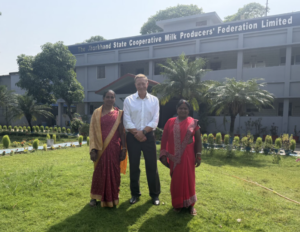
DSF Director, Brian Lindsay, on a recent visit to Jharkhand State Co-operative Milk Producers' Federation Limited, India
For these farmers, the opportunity to invest in a two cubic metre household biodigester has been life changing. Using biogas generated from their cows, they now have instant heat in the morning and can prepare a hot meal for their children before school without the need to invest hours going to the forest to collect firewood. Each woman is saving an estimated 624 hours per year, time that can now be redirected into farm work, family life, community engagement and rest.
The benefits extend well beyond the kitchen. The biodigester produces digestate that can be used as fertiliser on farm or sold, reduces the time and water needed to clean smoke-blackened cooking pots, and supports better use of farm resources. It is a practical example of circular economy principles working at household level—turning cow manure into energy, fertiliser, income opportunities and improved quality of life.
DSF Director Brian Lindsay heard first-hand how access to knowledge, practical training and appropriate technology is helping JMF’s supplying farmers improve production and efficiency. As members of the DSF, the implementation process ensures that the right criteria are the focus of their sustainability improvement efforts. Just as importantly, it is recognising women as empowered dairy farmers: skilled managers, innovators and decision-makers whose work strengthens both their households and the wider dairy sector.
As the global dairy community celebrates the contribution of women farmers, stories like this demonstrate what sustainable dairying can look like in practice: locally led, inclusive, resource-efficient and rooted in opportunity. When women dairy farmers have access to the right tools and support, the impact reaches far beyond the farm gate.