June DSF Member Profile: Dairy Farmers of Canada
June DSF Member Profile: Dairy Farmers of Canada
Dairy Farmers of Canada has been a member of the DSF since June 2014. This month, we invited Fiona McNeill-Knowles, Sustainability Manager, to provide further insights into the organisation’s sustainability focus and aligned actions.
About Dairy Farmers of Canada
Dairy Farmers of Canada (DFC) is a farmer-funded and farmer-run organization representing the interests of the hard-working men and women on over 9000 Canadian dairy farms. As a national federation, DFC members include dairy farmer organizations from all ten Canadian provinces.
What is the sustainability focus of DFC for the next 12 months?
The challenge we have identified is how do we support farmers to implement GHG emissions mitigation actions at farm level. To address this, a key initiative that DFC are particularly excited about is the formation of the Canadian Dairy Sustainability Coordinating Committee, a joint effort between Dairy Farmers of Canada and the Dairy Processors Association of Canada. The Committee brings together 19 representatives from both groups to advance sustainability across the Canadian dairy value chain and create a shared space for collaboration. Launched in January 2026, the Committee has already held several meetings. Its work is centred on shared priorities, particularly advancing on-farm emissions reduction, farmer incentives, and increasing the measurement, reporting, and verification of emissions reductions. The Committee is enabling farmers and processors to better understand each other’s pressures, align around common goals, and identify practical ways to move on-farm sustainability progress faster together. As part of implementing the DSF, DFC undertook a materiality assessment and identified GHG Emissions as one of the top priorities. The Committee is focussing on incentivising sustainable management practices to reduce emissions as a way to reduce emissions - coupled with a rigorous MRV process.
Following a series of workshops, the Committee has developed a multi-year shared action plan to guide its work and track progress. One emerging priority is a sustainability incentive model that would incentivize farmers for reducing emissions while ensuring those reductions can be measured and used within the dairy value chain.
A central question is how to fund such a model and build in strong measurement, reporting, and verification so emissions reductions are credible and usable for stakeholders’ reporting needs. Similar models exist internationally, but this would be a new approach in Canada, which is why the committee is moving quickly to turn the concept into action, with the goal of implementing a pilot to test the model on-farm in the year ahead and will be developing a timeline for scaling the on-farm pilot for national delivery in the future.
Can you tell us about an initiative you have implemented that has delivered some tangible results?
DFC’s recent On-farm Greenhouse Gas Calculator project has enabled individual farms to find out their carbon footprint and also supported the goal to have more frequent measurement of the national carbon footprint in addition to national life cycle assessments.
Round 1 (in 2024) - piloted the Cool Farm Tool on 41 farms across Canada to help farmers understand their carbon footprint. The project has helped participating farmers better understand emission sources with advisors helping to collect data, explain results, and identify practical best management practices to reduce emissions. In addition, this first round helped test the process, gather farmer feedback and details of any issues, and adapt the tool for the Canadian context.
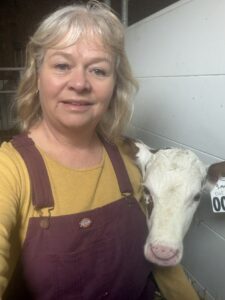
Janet Harrap, Canadian dairy farmer, in Fergus, Ontario. She participated as both a farmer and on-farm advisor in Round 1 and 2 of the ON-Farm GHG Calculator Project
In Round 2 (in 2025), the project expanded to 58 farms and tested both the Cool Farm Platform (the latest version of the Cool Farm Tool) and Agriclimat, a Quebec-developed calculator, to compare approaches and refine the process. Farmers then reviewed GHG emissions results with advisors and identified next steps to reduce emissions. Each farm received a continuity plan, giving the farmer a practical summary of their results, key emission sources, and tailored best management practices that could be implemented. Farmer feedback has been positive, and the pilots have helped DFC refine the process for using an on-farm GHG calculator across Canadian dairy farms to increase farmers’ knowledge of their GHG emissions and potentially use a calculator for annual national carbon footprint reporting, as required by customers and supply chain partners.
Université Laval supported data aggregation and analysis of both rounds to produce a test national carbon footprint estimate, increase data standardization and identify strengths and weaknesses for the calculators. Farmers were generally interested to see their individual results and benchmark themselves against others in their region. They expressed a motivation to improve their results and felt that an on-farm calculator could be useful to help direct management decisions to reduce GHG emissions and improve efficiencies.
The pilot also supports a longer-term goal of annual national carbon footprint reporting to complement the LCA conducted every five years.
We are also assessing how future rounds could meet third-party verification standards so results can support reporting while continuing to build farmers’ understanding of their emissions.
“It’s really hard to know how we can move the needle on your farm when you don’t know where you currently fit. Being able to have a starting point will help me know what difference a change in practice will make to my overall GHG output,” Janet Harrap, Canadian dairy farmer and on-farm advisor.