DSF Webinars: Sustainability in action on dairy farms in Latin America
DSF Webinars: Sustainability in action on dairy farms in Latin America
The 2025 Sustainability in action on dairy farms webinar series wrapped up last month with an inspiring final session featuring two dairy farmers from Latin America who shared practical, on-the-ground strategies for building resilient, sustainable dairy systems. Our thanks to our DSF member colleagues from Alpura, Mexico and Consorcio Lechero, Chile, who connected us with our farmer presenters.
 Mexico: sustainability through a strong emphasis on animal care and smart resource use
Gina Gutierrez, a fifth-generation dairy farmer and business manager, works with her father and brother on their 500-cow farm in Mexico’s Mezquital Valley. She noted that 80% of Mexican dairy farms are under 5 hectares, with notable differences between smallholder farms in the south and larger, more productive farms in north and central Mexico. All Mexican dairy farms, however, face shared challenges such as heat stress, soil erosion and water scarcity across the country’s diverse climates.
The Gutierrez family’s sustainability approach centres on animal care and efficient resource use.
- Optimising cow health and comfort is key to the wellbeing and productivity of the herd. Technology is utilised, such as pedometers and rumination tags, to closely monitor the animals’ health and wellbeing.
- Solar panels have generated power on the farm for 11 years, cutting reliance on fossil fuels, and this is an area that they plan to increase their capacity and efficiency in the future with newer solar technology.
- They have been operating a rainwater capture and recycling system for 23 years to flush wash their cow housing.
- Like many of the farms in the locality, recycled wastewater from Mexico City is utilised, being accessed via a vast, gravity-based canal and flood irrigation system. Drip irrigation using this wastewater enables the farm to grow high-quality forage in an otherwise dry region.
 Chile: people, biodiversity and pasture-based performance
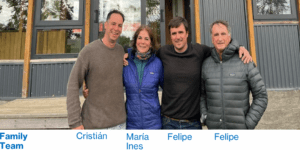
We also heard from Felipe Anguita, a first-generation farmer who left a career in civil engineering to start dairy farming with his wife in 1996 — “knowing nothing about farming,” as he openly joked. Today, their family business, Antillanca Spa, spans four farms in southern Chile, managed mostly by two of their three sons.
Their model blends pasture-based dairying with a deep commitment to staff wellbeing and environmental stewardship.
- Creating an optimal working environment and prioritizing staff welfare are fundamental principles for the farm business. Several employees have demonstrated long-term commitment, with some serving the farm for up to 29 years. The Anguita family has recognized notable advantages from encouraging playing sports and healthy nutrition amongst staff, their families, and the broader community, resulting in substantial improvements to both health and wellbeing as well as productivity.
- Their crossbred herd is bred specifically for a New Zealand-style grazing system, delivering high milk solids (9.2%) with lower emissions (a recent study on GHG emissions on their farm by Universidad Los Lagos concluded that their herd had about 30% lower emissions than other herds on pastoral systems).
- Over 40% of their land is native forest, home to 30 native tree species, 20 animal species and 35 bird species. The family are proud of the biodiversity on their land and are committed to nurturing this for future generations.
The Anguita family views profitability and sustainability as inseparable, with continuous improvement ensuring long-term viability.
Across 2025, the DSF has identified leading farmers from North America, Oceania, Africa, Europe, and now Latin America have offered rich insights into how sustainability is being implemented across regions and farm types. Their experiences have been invaluable — and we hope equally useful to you.
Missed a session? All webinar recordings are now available in the DSF Members Area.