Dairy sustainability front and centre at COP30 in Belém, Brazil
Dairy sustainability front and centre at COP30 in Belém, Brazil
Brian Lindsay, DSF Director and Global Sector Lead for Sustainability at the Global Dairy Platform (GDP), travelled to Belém last month to represent the global dairy sector at COP30. While the conference’s overall outcomes, especially the agriculture negotiations, may not have fully met global expectations, Brian’s time on the ground proved highly productive — offering valuable discussions and direct engagement with new and key international stakeholders who do not attend other events during the year.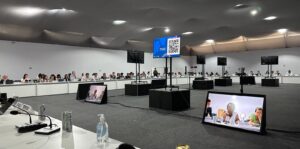
Throughout several official side events, DSF and GDP highlighted the dairy sector’s role in feeding a growing world population responsibly. Data provided by DSF members, the foundation of the DSF Annual Sustainability Progress Reports, underpinned these sharing opportunities by clearly demonstrating real, measurable progress across the sector under the three pillars of sustainability.
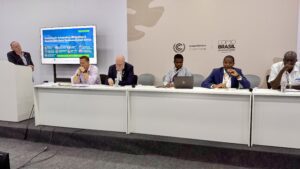 One such side event, on 15 November, Pathways to Dairy Net Zero took the spotlight during GDP’s official COP30 side event, “Investing in Adaptation, Mitigation and Sustainable Dairy Systems in East Africa.” The session underscored the potential of sustainable dairy systems to drive resilience and emissions reductions across the region.
The session showcased proven, scalable climate-smart dairy solutions and highlighted the sector’s growing momentum in commitment, tracking, action, and measurable impact. Donald Moore, Executive Director of GDP, moderated the discussion, joined by a high-level panel with speakers from the Governments of Kenya, Uganda and Tanzania, FAO, IFAD and the DSF.
Top Takeaways from the Session
- Scalable climate-smart dairy investment is already underway. The East Africa P2DNZ regional workstream — the DaIMA programme (Dairy Interventions for Mitigation and Adaptation) — demonstrated how Green Climate Fund financing combined with strong partnerships can cut GHG emissions while improving farmer livelihoods.
- Policy alignment unlocks climate finance. Kenya, Uganda, and Tanzania showed that harmonized policy frameworks create a pathway for meaningful public–private implementation at scale.
- Finance must reach farmers. Blended finance models, insurance schemes, local financial institutions, public funds, and bankable proposals are essential for supporting farmers, pastoralists, and cooperatives — especially where upfront costs pose barriers for smallholders.
- The Dairy Sustainability Framework adds unique value. DSF’s expertise in project development, monitoring, and delivery reporting strengthens the entire investment and implementation ecosystem.
What's the media has been saying about COP30…?
From BBC News: Five takeaways from a divisive climate summit
BBC News described COP30 as one of the “most divided” climate conferences in recent years. While countries made advances in adaptation planning and climate finance pledges, deep disagreements persisted on fossil fuel phase-out language and funding responsibilities. The BBC noted that despite divisions, momentum on food systems, land restoration, and subnational action — including agriculture and livestock initiatives — was more prominent than in previous COPs. Read the full article