Boosting Livestock Sector Growth with Low Emissions – a strategic approach in Eastern and Southern Africa
Boosting Livestock Sector Growth with Low Emissions – a strategic approach in Eastern and Southern Africa
A new report has been released by the World Bank, Boosting Livestock Sector Growth with Low Emissions – a strategic approach in Eastern and Southern Africa.
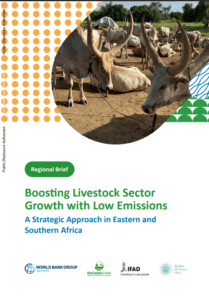 The report’s focus is specifically on tackling emissions within its rapidly expanding livestock sector, advocating for a responsible growth strategy. Livestock plays a critical economic and social role both globally and in the Eastern and Southern Africa region. The livestock sector encompasses a variety of species, with cattle being the most prominent in the region. The report broadly addresses three key questions: which systems are producing emissions? Why is this significant for the region? And how can emissions be managed in a manner that simultaneously promotes sectoral growth?
Some of the proposed strategies for action include:
- Altering feeding practices through the use of better feeds, governments to prioritise research programs that develop high quality feed with a low carbon footprint and improve extension and advisory services to disseminate viable solutions with locally available feedstuffs.
- Improve cattle genetics and breeding practices to encourage fewer more productive animals along with encouraging practices to boost reproductive performance.
- Restoring landscapes, including rangelands, to sequester carbon whilst enhancing water storage and soil fertility to sustain higher productivity in the long term.
- How to incentivise and finance responsible growth in the livestock sector.
For more details and to download a copy of the report click here.