Bonn Climate Talks: Agriculture Discussions Continue
Bonn Climate Talks: Agriculture Discussions Continue
During June, governments met in Bonn for the UN Climate Change Conference, where agriculture was discussed under the Sharm el-Sheikh Joint Work on Agriculture and Food Security. Around 190–200 Parties (countries) were represented, with approximately 6000 people participating. Governments were not able to agree on detailed conclusions and instead agreed to postpone substantial decisions to the next meeting in November. Discussions on the future of the agriculture work will continue ahead of COP31 in Turkey.
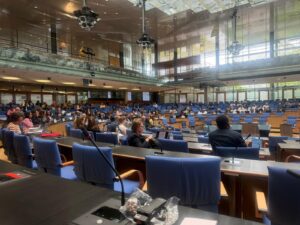
Negotiations underway at UN Climate Change Conference, Bonn
A three-day workshop also took place during the session, focusing on finance, innovation, technology and capacity building to support climate action in agriculture. Brian Lindsay, Director of the Dairy Sustainability Framework (DSF), delivered an intervention on behalf of the Business and Industry NGO constituency (BINGO), highlighting the importance of practical action, partnerships and the role of farmers and businesses in delivering solutions. Brian also followed the subsequent negotiations closely, helping adapt and deliver BINGO messages as discussions evolved.
The Dairy Sustainability Framework was also featured during the workshop’s interactive World Café discussions. Participants from governments, UN agencies, business and civil society exchanged practical examples of action already taking place on the ground. Through these discussions, the DSF model helped demonstrate how measurement, continuous improvement and collaboration across the dairy value chain can support climate action. The World Café engaged around 150 participants from a wide range of sectors and regions.
In addition, DSF was invited to join a separate FAO-led workshop on the future of agriculture under the UNFCCC to provide the essential private sector perspective. This provided an opportunity to share practical experience from the dairy sector and contribute to wider reflections on how the UNFCCC agriculture discussions could better support implementation on the ground.