April DSF Member Profile: Fonterra
April DSF Member Profile: Fonterra
The DSF is profiling members in each issue. Fonterra has been a member of the DSF since October 2013. This month, we invited Charlotte van der Lee, Sustainability Manager at their Amsterdam office, to provide further insights into the organisation.
About Fonterra
Fonterra operates as a cooperative, owned by thousands of farming families in New Zealand. The company manages all aspects of dairy collection, processing, and global marketing. While headquartered in New Zealand and committed to delivering value to local farmers, Fonterra conducts business on an international scale and is among the world’s leading dairy exporters, with approximately 95% of its products distributed overseas.
Geographically, where do you operate?
Although all supplying dairy farmers are based in New Zealand, Fonterra sells its dairy products to more than 100 countries worldwide. The company maintains offices in key locations such as Chicago, Shanghai, Amsterdam, Dubai, and Singapore, among others.
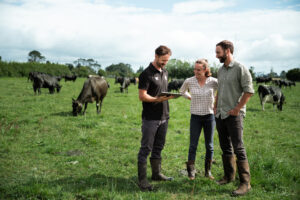
Fonterra’s Sustainable Dairying Advisors play a key role in supporting farmers to identify and mitigate on-farm environmental risk
What’s the sustainability focus for Fonterra in the next 12 months?
In 2021, Fonterra notably emphasised sustainability within its refreshed strategy, with being a leader in sustainability, one of its three strategic priorities. Sustainability has continued to be a core strategic focus since, which has guided the development of a climate roadmap, increased public emissions reporting, enhanced transparency around product footprints, partnership with customers to deliver sustainability outcomes, and supported regulatory compliance in global markets. The industry has addressed many initial opportunities for emission reduction in recent years. Fonterra now seeks to confront the emerging challenge of plateauing industry-wide emission reductions through collaboration, sharing best practices, and investing in technological innovation and research to accelerate progress toward defined targets.
Climate adaptation also remains a significant focus. Fonterra encourages long-term planning beyond 2030, aiming to achieve net-zero emissions by 2050 and respond effectively to changing environmental conditions due to rising temperatures. Over the coming year, the organisation plans to engage extensively with its supply chain and customers to discuss climate adaptation strategies and reinforce its commitment to ensuring a resilient and secure supply of dairy from New Zealand.
Can you tell us about a sustainability initiative that has delivered tangible results?
Fonterra is particularly proud of its Farm Environment Plans (FEP), introduced in 2017 and since 2025 has achieved 100% FEP coverage across all Fonterra supplying farms in New Zealand. Each plan is customised to the individual farm and developed collaboratively with farmers and sustainable dairy advisors. Farms are GPS mapped, and FEPs address specific local environmental risks and opportunities, as well as covering soil health, biodiversity, water quality, nutrient management, waste management, and overall farm hygiene. Initially a voluntary programme, FEPs have since become mandatory under Fonterra's supply terms.
This has been one of the ways Fonterra has driven on-farm improvements across its New Zealand milk supply. Some of these improvements have been reported via Fonterra’s Regenerative Agriculture approach (comparing 2020/21 data to 2023/24) including:
- A 6% reduction in purchased nitrogen surplus indicating improved nutrient management
- Reduced somatic cell count indicating improved animal welfare and performance
- Reduced emissions intensity
Improvements in biodiversity are expected due to native planting in marginal lands and riparian zones, with innovative measurement of this using AI-driven insights from satellite and drone imagery being used this season.
More information can be found:
- The Fonterra Climate Roadmap
- Farm Environment Plans
- Fonterra Regenerative Agriculture
- Group Climate Statements (including transition planning) - Annual Report pgs 178-226
If you would like your organisation profiled, please contact the DSF secretariat.