New UN Report: The Global Environment Outlook – A future we choose
New UN Report: The Global Environment Outlook – A future we choose
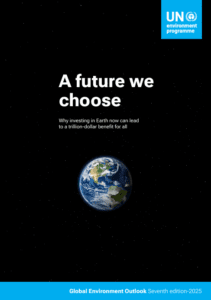 Launched on 9 December at UNEA-7 in Nairobi, the Global Environment Outlook, Seventh Edition (GEO-7): A Future We Choose is being billed as UNEP’s most comprehensive environmental assessment yet. Drawing on insights from 287 scientists across 82 countries, the report delivers a clear message: investing in climate stability, healthy ecosystems, and pollution reduction doesn’t just protect the planet — it boosts GDP, saves lives, and reduces poverty and hunger.
GEO-7 warns that despite years of international initiatives, the world is facing unprecedented environmental stress — from climate change and biodiversity loss to land degradation, desertification, pollution and waste. These crises reinforce each other and are driven largely by unsustainable production and consumption patterns (not just food – materials for example). Under current policies, most global targets will not be met.
The good news is that solutions exist. The report stresses that transformational, cross-sectoral action at scale can still shift us onto a sustainable path. Reforming economic and financial systems is highlighted as the catalyst needed to unlock rapid progress across:
• Material and waste systems
• Energy systems
• Food systems
Such integrated approaches can accelerate environmental gains while also delivering substantial social and economic benefits. This is not dissimilar to how the DSF 11 criteria are acknowledged – none stand alone and, in most cases, it is the interrelationships with other criteria that is critically important.
GEO-7 emphasises that solutions must be carefully tailored to regional social, economic, and ecological realities. Customised strategies will maximise impact and ensure lasting, equitable outcomes — paving the way for a healthier, more resilient planet for generations to come.